Energy and trend data
15-minute values via REST with an API token or as files via SMB pull. Buffered if the broker is unavailable.
REST · SMB pull

Technology · Building automation & IoT
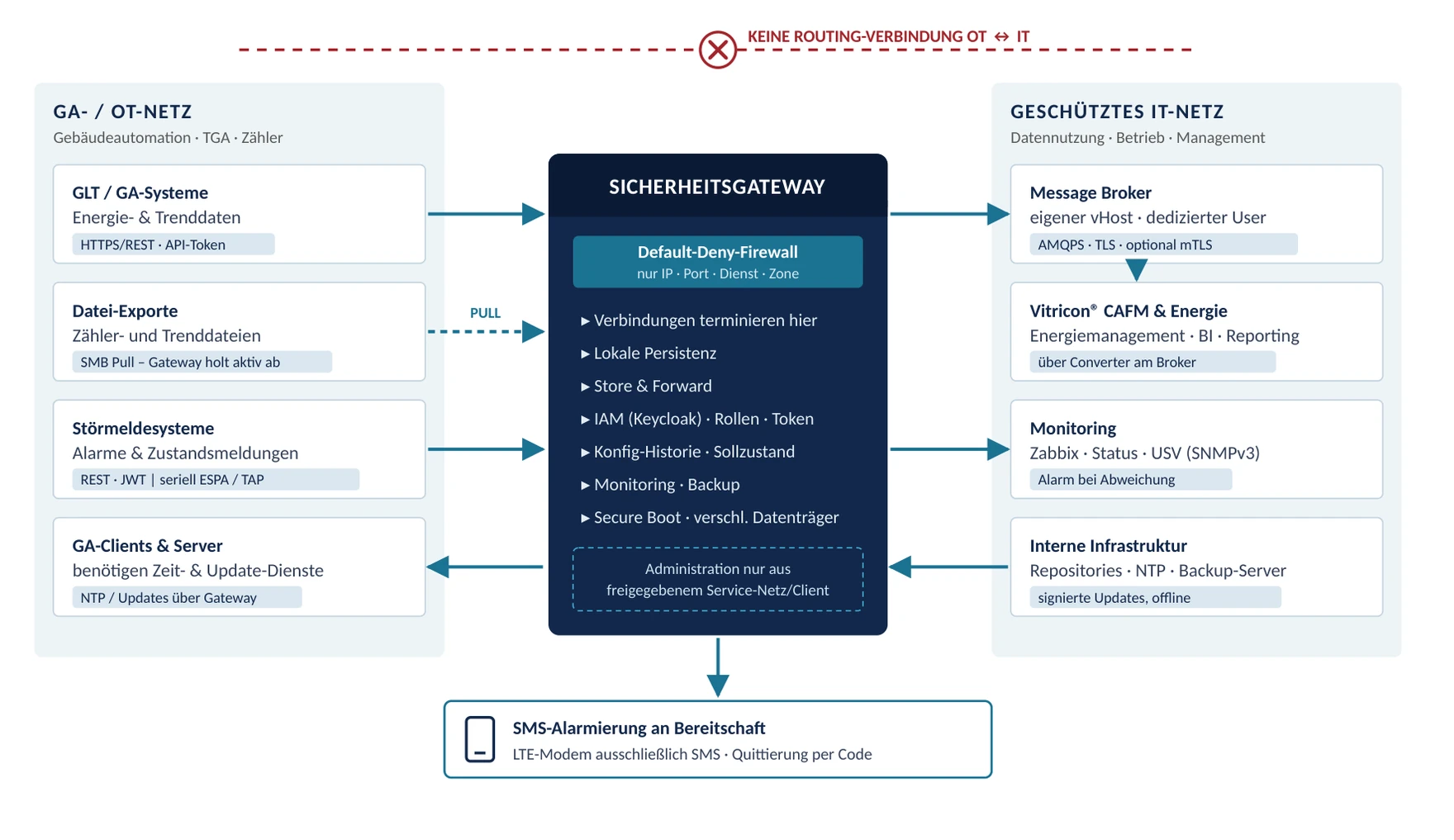
The controlled data boundary between OT and IT: the VITRICON® Security Gateway passes trend data, fault messages and energy values from building automation to IT. No routing, no network opening, no internet.
For operators of complex facilities and critical infrastructure
If your building management system delivers trend data, fault messages and energy values to IT, it is part of your attack surface. The VITRICON® Security Gateway passes on exactly this data and nothing else.
The VITRICON® Security Gateway is VITRICON®'s own hardware and has been in operation for many years, above all with the German Armed Forces (Bundeswehr) and with other large operators.
As soon as the BMS, energy monitoring, CAFM or a control room exchange data across network boundaries, a security transition is created. Layer 3 separation separates networks, not data flows.
The VITRICON® Security Gateway forms a zone of its own between the BA network and the protected IT. Every connection terminates there, is stored locally and only then passed on via a defined, encrypted channel.
Architecture
Business processing deliberately stays in the downstream systems. The VITRICON® Security Gateway focuses on handover, control and operational security.
Your functions
Each data flow has its own, clearly defined path through the VITRICON® Security Gateway. Everything else stays blocked.
15-minute values via REST with an API token or as files via SMB pull. Buffered if the broker is unavailable.
REST · SMB pull
Via REST with a short-lived JWT or serially via ESPA/TAP. Passed on to IT and by SMS to on-call staff.
REST · ESPA/TAP · SMS
Time and update servers for BA systems are provided selectively, without a general approval.
NTP · Updates
Handover to IT via a message broker over AMQPS with TLS, optionally mTLS, with its own vHost and a dedicated user.
Where the data goes: VITRICON® EMS – energy monitoring and analysis
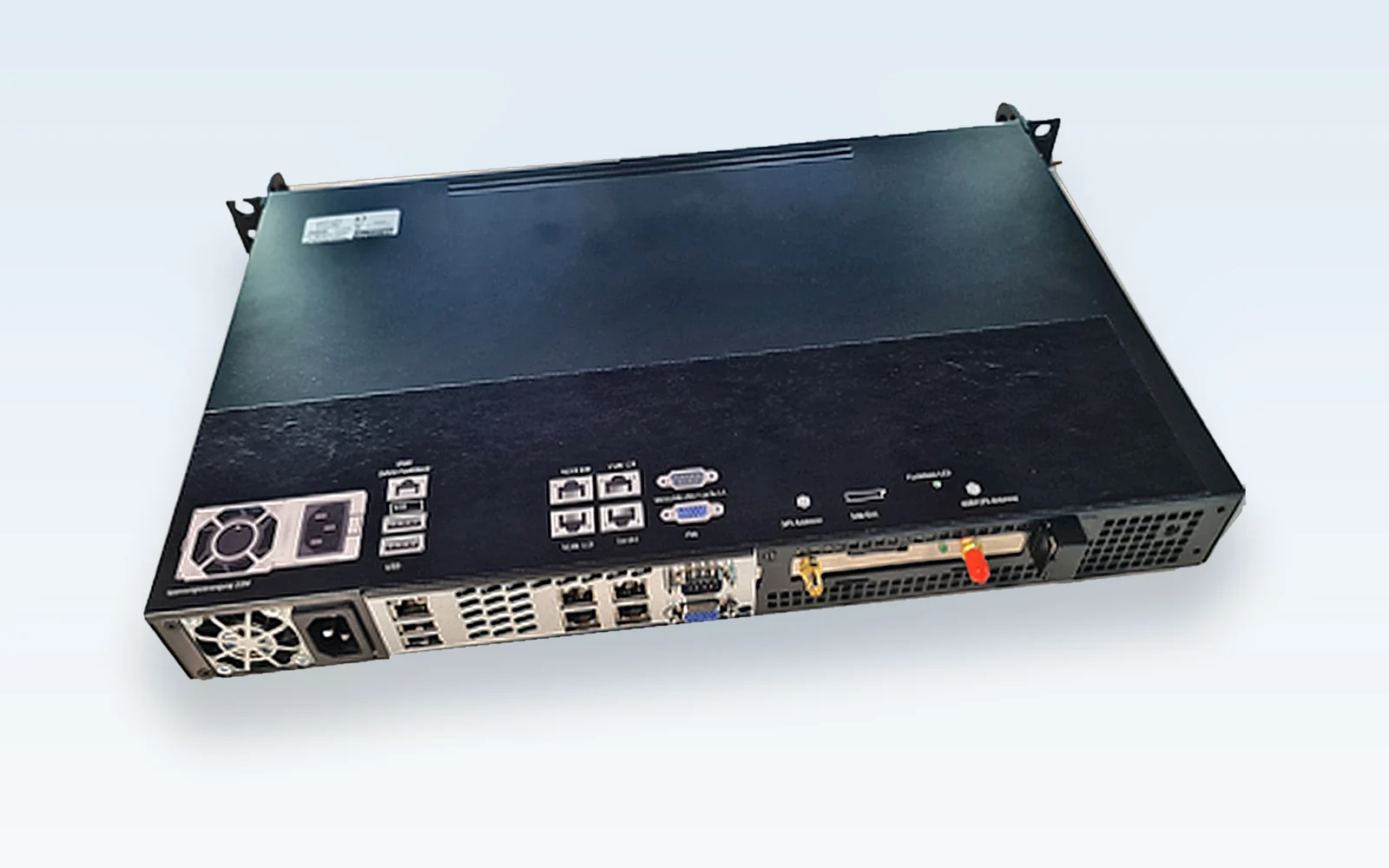
The VITRICON® Security Gateway is a dedicated appliance for operation in a locked technical or server room. The rear panel holds the separate network ports, the serial interface and the LTE modem.
Availability
The VITRICON® Security Gateway keeps operations running when target systems fail and is quickly back after a disruption.
If the broker or target systems fail, the gateway stores the data locally and delivers it later.
At every start the gateway re-enforces its secured target state. This secures the restart.
A replacement device is quickly made ready from the configuration backup.
Deliberately transparent: the concept is designed as a single appliance. Availability relies on a controlled restart, persistence and fast recovery, not on a second HA gateway.
Your benefits
No routing connection, no internet, only explicitly approved services. Open ports and forgotten remote access lose their effect.
Attack surface
A compromised BA controller cannot reach the administrative IT, and ransomware from IT cannot reach the building services. The incident stays local.
Blast radius
Store & forward buffers energy and trend data during IT outages, SMS alerting works even without IT. Restart from a secured target state.
Outage impact
Documented approvals, roles and configuration history provide proof for audits, NIS2 obligations and management accountability.
Liability risk
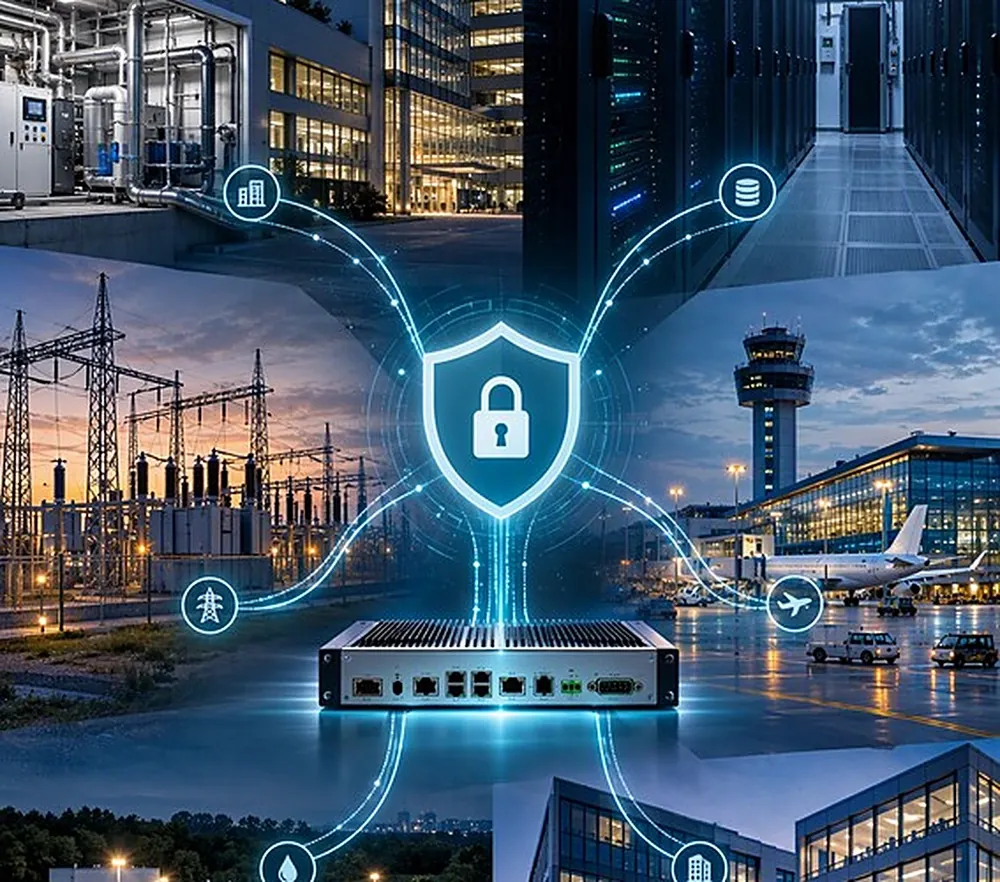
The VITRICON® Security Gateway is designed for facilities where data from building services has to flow while the BA network stays protected: for reliable consumption data in energy management, for trend and condition data in CAFM, maintenance and control rooms without remote access to the BA network, and for fault messages that reach on-call staff even when IT is down.
Industry: Authorities and defence
The German Federal Office for Information Security (BSI) puts it clearly: OT must be segmented and separated from all other networks. The VITRICON® Security Gateway is a technical measure for controlled OT/IT coupling and supports the implementation of these requirements. It does not replace a risk analysis or an ISMS.
FAQ
A dedicated 19-inch appliance from VITRICON® that forms its own network zone between building automation (OT) and the protected IT. The VITRICON® Security Gateway passes on energy and trend data, fault messages and infrastructure services in a controlled way, without creating a routing connection between OT and IT.
The VITRICON® Security Gateway has been in operation for many years, above all with the German Armed Forces (Bundeswehr) and with other large operators. It is designed for operators of complex facilities and critical infrastructure, such as public authorities, hospitals, data centres, utilities, airports and large real estate portfolios.
No. Updates come as signed packages from internal repositories or are installed on site by the service team. The LTE modem is used exclusively for SMS alerts; mobile data is disabled.
The VITRICON® Security Gateway stores energy and trend data locally and delivers it later (store & forward). Fault messages still reach on-call staff by SMS. After a restart, the VITRICON® Security Gateway automatically re-enforces its secured target state.
Energy and trend data via REST/HTTPS with an API token or as files via SMB pull, fault messages via REST with a short-lived JWT or serially via ESPA/TAP. The handover to IT runs through a message broker over AMQPS with TLS, optionally mTLS.
The VITRICON® Security Gateway includes a default-deny firewall and replaces the generic coupling of OT and IT via routing. It does not replace a risk analysis or an ISMS; it is a technical measure that supports their implementation.
Test free of charge
Basic website functions and form submission. Cannot be disabled.
Google Analytics 4 for pseudonymised analysis of website usage, delivered via Google Tag Manager. Nothing is loaded without your consent.
In addition, Leadfeeder (Dealfront) identifies the companies behind website visits (B2B). If you submit a form, the visit history is also linked to your contact details.